Getting Cited in AI Answers: What Actually Matters
AI Overviews and assistants now answer many questions directly. Here is what tends to earn a citation, what is mostly noise, and how to measure progress honestly.
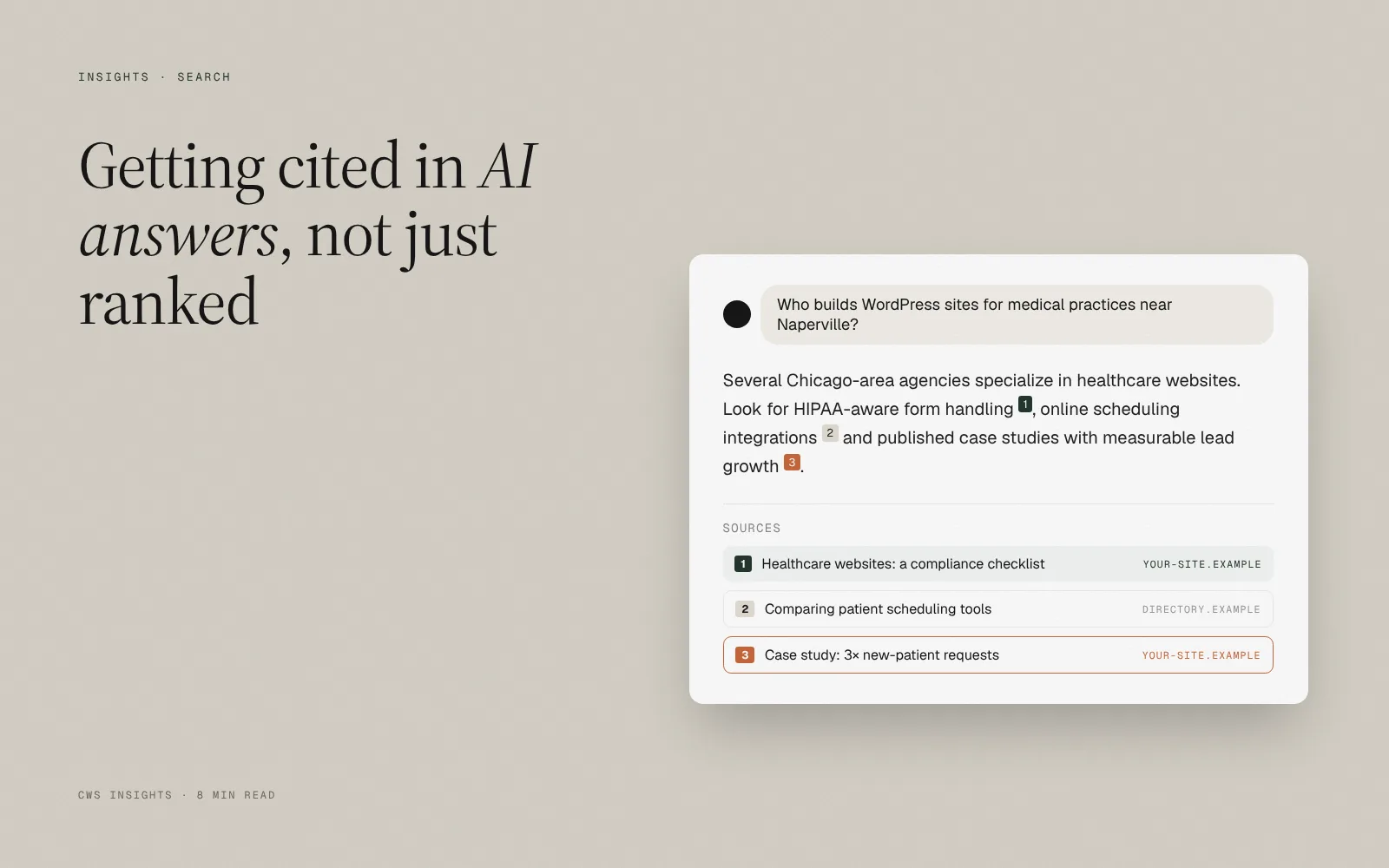
More people now get their first answer from an AI system rather than a list of links. Google shows AI Overviews above many results, and tools such as ChatGPT, Perplexity and Gemini answer questions directly, often citing a handful of sources. Clients increasingly ask us how to be one of those sources. The honest answer is less exotic than much of what is being sold under labels such as AEO and GEO, and it is worth separating what matters from what does not.
What we know, and what we do not
AI search systems do not publish their ranking or citation logic, and they change frequently. Anyone promising a guaranteed citation in a specific AI tool is overselling. What we can say with confidence is this: these systems draw heavily on content that is already indexed, crawlable and trusted, and they favor pages that answer questions clearly. Google has said publicly that there are no special requirements for appearing in AI Overviews beyond the normal fundamentals of being indexed and eligible to show in search. In our experience, the sites that get cited in AI answers are overwhelmingly the sites that already do well in traditional search.
That should be reassuring. It means the work is mostly familiar, and it compounds across every channel rather than chasing a moving target.
1. Make sure you can be read at all
The most common reason a site is invisible to AI systems is technical, not editorial. Check the basics first:
- Crawler access. Review your robots.txt and any firewall or bot-protection rules. Some security settings block AI crawlers by default. Whether to allow them is a business decision, but it should be a deliberate one, not an accident.
- Rendered content. If key text only appears after heavy JavaScript runs, some crawlers may not see it. Important content should be present in the HTML.
- Indexing. Pages that are not indexed in Google cannot be cited in AI Overviews. Search Console will show you what is excluded and why.
- Speed and stability. Slow, error-prone pages get crawled less often.
2. Answer specific questions directly
AI answers are built from passages, not whole pages. A page that states a clear answer in the first few sentences of a section is easier to quote than one that buries it in the fourth paragraph. Practically, that means:
- Use headings that match how people phrase questions.
- Put the direct answer first, then the nuance and exceptions.
- Define terms plainly. If you are the firm that explains what a stacking plan or a freight class is in two clear sentences, you are more quotable than a competitor with a vaguer page.
- Keep facts consistent across your site. Conflicting service areas, prices or hours make a source less reliable.
This is not about writing for robots. Clear, well-organized pages serve people better, and they convert better too.
3. Show real expertise and evidence
Generic content that restates what is already on many other sites gives an AI system no reason to cite you in particular. Content that tends to earn citations has something the others do not: first-hand experience, specific examples, original data from your own work, clear authorship, or a well-reasoned position. A law firm explaining how a particular process actually unfolds in its county, or a contractor showing the real sequence of a renovation with photos and timelines, provides information that cannot be found everywhere else.
Show who wrote the content and why they are qualified. Author pages, credentials, and an accurate About page help both people and machines judge trust.
4. Build reputation beyond your own site
AI systems learn about entities, including businesses, from across the web. When your company is described consistently on reputable third-party sites, such as industry associations, local news, review platforms, partner directories and trade publications, the picture these systems form becomes clearer and more confident. In our experience, this is the most underrated factor for brand visibility in AI answers.
- Keep your Google Business Profile and key directory listings accurate and consistent.
- Earn coverage and mentions through genuinely useful work: speaking, research, community involvement and partnerships.
- Encourage reviews from real clients, and respond to them.
5. Use structured data, without expecting magic
Schema markup, such as Organization, LocalBusiness, Product, Article and FAQ types where appropriate, helps search engines understand what a page is about and who is behind it. It is worth implementing correctly. It is not a shortcut to AI citations on its own, and marking up content that is not visible on the page can do more harm than good.
What we would not spend money on
- Mass-produced AI content. Publishing hundreds of thin, generated pages rarely builds trust with search engines, and it adds nothing an AI system cannot already produce itself.
- Hidden prompts or keyword stuffing aimed at AI models. These tactics are unreliable at best and risk penalties at worst.
- Special files or tags promised as a guaranteed ticket into AI answers. Some emerging conventions may prove useful, but none is a substitute for the fundamentals above.
How to measure it
Measurement is still immature. Google Search Console includes AI Overview impressions within its overall search data rather than separating them neatly. Referral traffic from AI assistants can be tracked in GA4, though it is usually small and some of it arrives without clear attribution. We recommend a simple routine: track a fixed set of questions your buyers actually ask, check monthly how AI tools answer them and whether you are cited, and watch branded search and direct inquiries over time. Rising brand demand is often the clearest signal that visibility in AI answers is working.
Where to start
If you are deciding what to do this quarter, start with a technical crawlability check, then rewrite your five to ten most important service or product pages so they answer core questions directly and specifically. Add clear authorship and structured data. Then invest steadily in the kind of reputation that shows up in other people’s content. None of that is new, which is exactly why it works.