Conversion Optimization for Service Businesses: Where Leads Actually Leak
Service businesses rarely need more traffic as much as they need more of it to call. Six common leaks we find on service websites, and how to fix them without huge traffic.
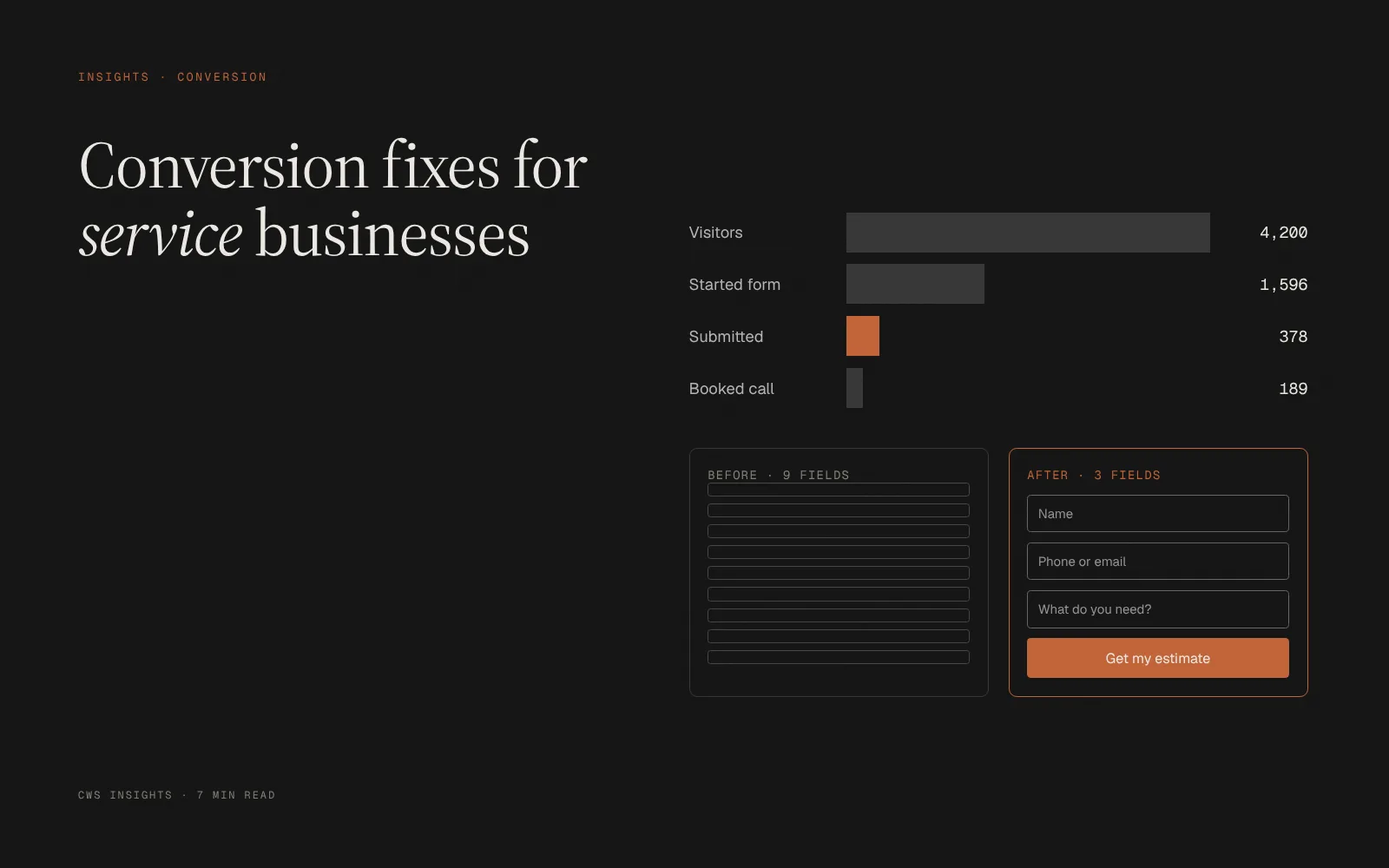
Service businesses rarely have a traffic problem as severe as they think. More often, they have a conversion problem: people arrive, look around and leave without calling, booking or filling out a form. Conversion optimization for a law firm, contractor, clinic or B2B service company looks very different from e-commerce CRO. There is no cart to optimize, sales cycles are longer, and a single lead can be worth thousands of dollars. Here is where we see leads leak most often, and what tends to fix it.
Start by measuring the right thing
Before changing anything, make sure you know what a conversion actually is and that you are counting it. On many service websites we audit, tracking is incomplete: phone calls are not tracked, form submissions are counted twice, or chat leads are not recorded anywhere. Fix that first.
- Track every lead type: form submissions, phone calls from the website, booking requests, chat conversations and email clicks.
- Use call tracking with dynamic numbers so you can see which pages and channels produce calls. For many local service businesses, calls are the majority of leads.
- Connect leads to outcomes. Send lead source data into your CRM so you can see which leads became clients, not just which ones submitted a form.
Optimizing for raw form volume can backfire. A change that doubles inquiries but fills the pipeline with poor-fit leads is not an improvement.
Leak one: the visitor cannot tell if you serve them
Within a few seconds, a visitor needs to know three things: what you do, where you do it and whether you work with people like them. Many service sites open with a vague headline and a stock photo. Replace that with a plain statement of the service and the area, supported by a specific detail that signals fit, such as the types of clients you serve, the size of projects you take on, or the insurance plans you accept.
Leak two: too many choices, or none
Some sites offer five competing actions on every page. Others hide the contact path entirely. Pick one primary action per page, usually a call or a consultation request, and make it visible without scrolling on mobile. Secondary actions, such as downloading a guide or reading case studies, should support that main action rather than compete with it.
On mobile, a persistent tap-to-call button often outperforms everything else for urgent services such as plumbing or legal emergencies. For considered purchases, such as a remodel or financial planning, a well-designed consultation request usually works better.
Leak three: forms that ask too much or too little
The conventional advice is to shorten forms. That is often right, but not always. Removing every qualifying question can increase volume while lowering quality, leaving your team to sort through inquiries that were never a fit.
A better approach is to ask only what you genuinely need to respond well. For a contractor, that might be the project type, location and timeline. For a B2B firm, it might be company size and the problem being solved. Multi-step forms can help when you need more detail: start with an easy question, then ask for contact information once the visitor is invested. Always explain what happens after submission and how quickly someone will respond.
Leak four: no reason to believe you
Service buyers are taking a risk on someone they have not met. Proof reduces that risk, but generic proof does little. Five-star badges and “trusted by hundreds” claims are easy to ignore. What persuades:
- Specific reviews that mention the service, the situation and the outcome.
- Case studies or project examples with real details, photos and timelines.
- Clear credentials, licenses and affiliations, stated plainly.
- Real photos of your team, vehicles, office or work, not stock imagery.
- Transparent information about process, timing and, where possible, pricing ranges.
Place proof near the decision point, beside the form or call button, not only on a separate testimonials page nobody visits.
Leak five: slow pages and broken mobile experiences
Many service leads come from phones, often in a hurry. Pages that load slowly, buttons that are hard to tap, and forms that fight with mobile keyboards cost leads quietly. Test your key pages on a mid-range phone over a cellular connection, not on the office Wi-Fi. Fix the obvious problems: oversized images, intrusive pop-ups, tiny tap targets and fields that open the wrong keyboard.
Leak six: the follow-up
This one is not on the website, but it is where many conversions are lost. In our experience, response speed is one of the strongest predictors of whether a service lead becomes a client. If inquiries sit in a shared inbox until the next business day, competitors who responded within the hour often win the work. Route leads to the right person automatically, set clear response targets, and send an immediate confirmation that tells the prospect what to expect.
How to test without enough traffic
Classic A/B testing needs substantial traffic to produce reliable results, and many service businesses do not have it. That does not mean you cannot improve. Use a mix of methods:
- Session recordings and heatmaps to see where people hesitate or abandon forms.
- Short surveys asking visitors what stopped them from getting in touch.
- Sales team input. Your staff hear the same questions every day; those questions belong on the website.
- Before-and-after comparisons over a sensible period, while accounting for seasonality and changes in marketing spend.
When traffic allows, test larger changes, such as a new page structure or offer, rather than button colors. Small tweaks rarely produce differences you can detect on a modest sample.
A practical order of operations
If you are starting from scratch, this sequence has worked well for our service clients: fix tracking, then clarify the message at the top of key pages, then simplify the primary action and form, then add specific proof near the decision point, then improve mobile speed, and finally tighten follow-up. Most businesses find meaningful gains in the first three steps alone.
Conversion work is not a one-time project. Markets shift, competitors change their offers, and your own services evolve. A quarterly review of tracking, key pages and lead quality keeps the site working as hard as the people behind it.