How Much Does a Professional Website Cost in 2026?
Realistic 2026 ranges for marketing sites, e-commerce builds and custom platforms from a senior Chicago agency, plus what actually moves the number and where budgets go wrong.
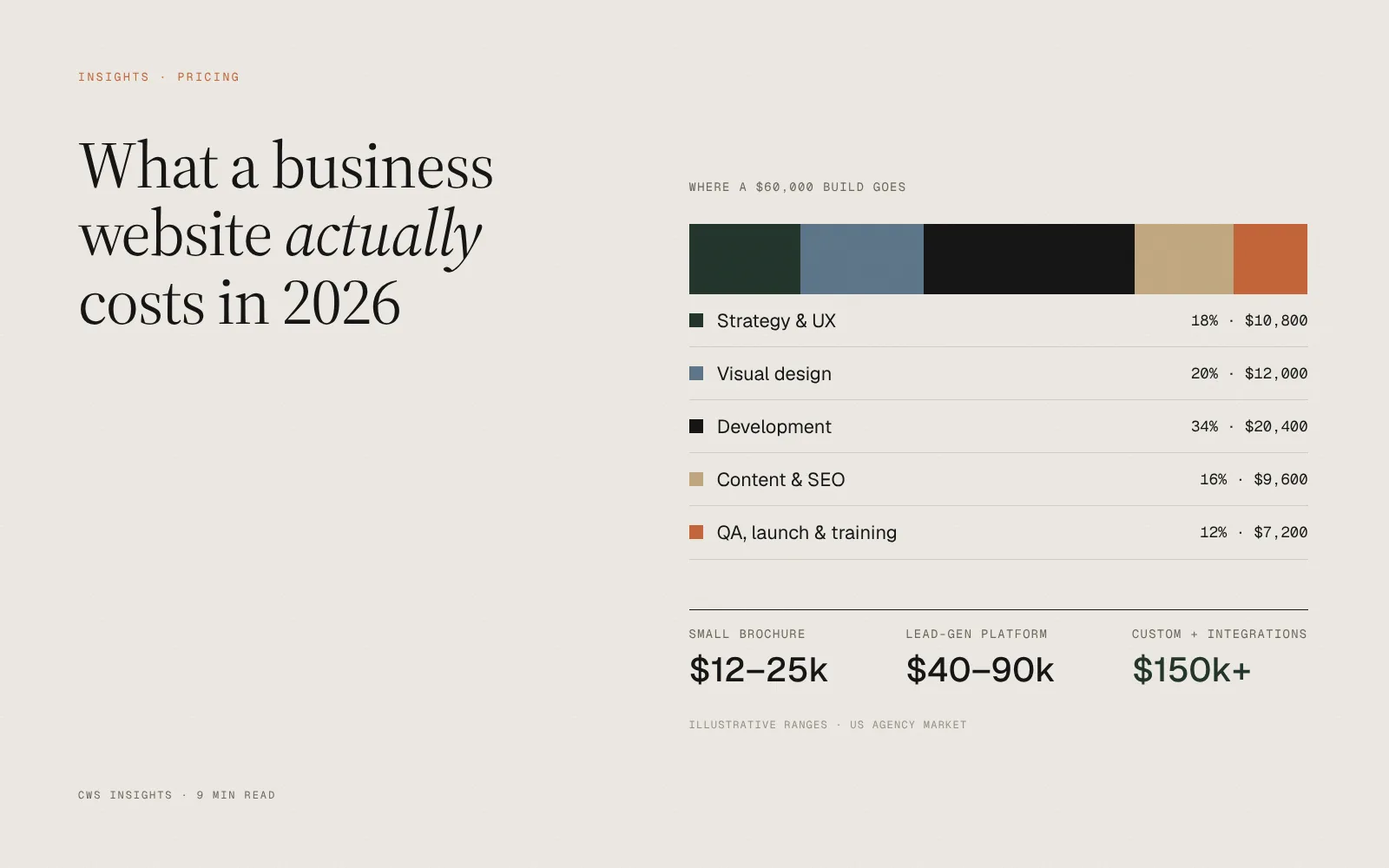
It is the first question almost every prospective client asks, and the honest answer is still “it depends.” That answer is useless on its own, so this article explains what it depends on, gives the ranges we actually see on our own projects, and points out where budgets most often go wrong. The figures below reflect what a senior agency in the Chicago market charges in 2026. Freelancers and offshore teams will quote less, and large national firms more.
The short answer
In our experience, most professional projects fall into three bands:
- Marketing websites: roughly $15,000 to $60,000.
- E-commerce stores: roughly $25,000 to $120,000.
- Custom platforms, portals and web applications: $60,000 and up, often well beyond $150,000.
Those ranges are wide because the projects inside them are genuinely different. A twelve-page site for a professional services firm and a sixty-page site with a resource library, three integrations and a migration from an older CMS are both “marketing websites.” They are not the same amount of work.
What actually drives the number
Page count is the measure most people reach for, and it is one of the least useful. What matters more is how many distinct templates and components a site needs, how much original thinking goes into them, and what has to connect to what. The main cost drivers, in rough order of impact:
- Strategy and discovery. Interviews, analytics review, competitive research, sitemap and content planning. Skipping this is the most expensive saving a client can make.
- Unique templates and components. A homepage, a service page, a case study and a blog post are four templates. Fifty service pages built on one template cost far less than ten pages that each need a different layout.
- Integrations. CRM, marketing automation, scheduling, ERP, inventory, payment and custom APIs. Each one adds design, development and testing time, and some add ongoing maintenance.
- Content. Who writes it, who approves it, and how much already exists. Content is where timelines slip most often.
- Migration. Moving hundreds of posts or products, preserving URLs and redirects, and protecting search rankings through the switch.
- Review and approval. A project with one decision-maker moves faster than one that needs sign-off from a board, legal and compliance.
Marketing websites: $15,000 to $60,000
At the lower end of this band, you are typically looking at a focused site of ten to twenty pages, built on a custom WordPress theme with a small library of reusable blocks, using content the client mostly supplies. Design is original but disciplined, and there are one or two simple integrations, such as forms flowing into a CRM.
Toward the upper end, the site usually involves a full brand-aligned design system, a larger component library, professional copywriting, a content migration, several integrations, and SEO work to protect existing rankings. Timelines run from about eight weeks for a focused site to four months or more for a larger one.
E-commerce: $25,000 to $120,000
E-commerce costs vary with catalog complexity and how much of the buying experience needs to be custom. A Shopify or WooCommerce store with a custom theme, a few hundred products and standard checkout sits near the bottom of the range. Costs rise with product configurators, subscriptions, B2B pricing and wholesale portals, multi-currency or multi-location inventory, and integrations with ERP or fulfillment systems. Product data cleanup is a line item people often forget, and on a large catalog it can take weeks.
Custom platforms and portals: $60,000 and up
Customer portals, scheduling systems, quoting tools and internal dashboards are software projects, not websites, and they should be budgeted that way. They need product discovery, user research, a defined data model, security planning, testing and a plan for ongoing development. We usually recommend a paid discovery phase first, typically a few weeks, so the build estimate is grounded in real requirements rather than guesswork. For anything that handles sensitive data, such as patient or financial information, expect additional cost for compliance work and infrastructure.
The costs that are easy to forget
A build quote covers the build. Most organizations also need to budget for:
- Photography and video. Original imagery does more for credibility than almost any design decision. A shoot can range from a few thousand dollars to considerably more.
- Software and licenses. Premium plugins, apps, fonts, maps and analytics tools, many billed annually.
- Hosting. Managed WordPress hosting for a business site is usually a modest monthly cost. Platforms with heavier traffic or compliance requirements cost more.
- Maintenance and support. Updates, security monitoring, backups and small changes. Plan for an ongoing monthly retainer rather than treating launch as the end.
- Marketing after launch. A new site does not bring traffic on its own. SEO, content and paid media are separate budgets.
Why cheaper quotes look the way they do
A $5,000 website quote is not necessarily dishonest. It usually means a pre-built theme with your logo and colors applied, minimal strategy, client-supplied content dropped into existing layouts, and little or no testing across devices. For a new business that needs a credible presence quickly, that can be the right call.
The problems show up later. Page builders and heavy themes are often slow. Layouts break when someone edits content in a way the template did not expect. Integrations are bolted on with plugins rather than built properly. When the site needs to grow, it often has to be rebuilt, which means paying twice. We see this pattern regularly when organizations come to us after a few years on a low-cost build.
How to budget sensibly
Start with what the website has to accomplish, not what it should look like. If it needs to generate qualified leads, how much is one new client worth to you? If it needs to sell products, what would a modest improvement in conversion rate mean in annual revenue? Framing the budget against business value makes the decision far clearer than comparing quotes line by line.
A few practical rules of thumb from our own projects:
- Set aside 10 to 15 percent of the build budget as contingency for scope you discover along the way.
- Plan annual maintenance and hosting at roughly 10 to 20 percent of the original build cost.
- If the scope is uncertain, pay for discovery first. It almost always saves more than it costs.
- Phase what you can. Launch the core site, then add the portal, the configurator or the resource library once real usage tells you what matters.
Questions to ask any agency, including us
- What exactly is included, and what would count as a change request?
- Who will actually work on our project, and how senior are they?
- Will we own the code, design files and content when the project ends?
- How do you protect existing search rankings during a migration?
- What does support look like after launch, and what does it cost?
A good agency will answer each of these plainly. If you would like a realistic range for your own project, we are happy to talk it through, and we will tell you if a smaller engagement is the better fit.