Shopify vs WooCommerce: How to Choose the Right Platform
Both platforms are capable. The right choice depends on how you sell, who runs the store and how much of the system you want to own. A practical comparison from a team that builds on both.
Shopify and WooCommerce power a large share of independent online stores, and both are capable platforms. The right choice depends less on which is “better” and more on how your business sells, who runs the store day to day and how much of the system you want to own. We build on both, so here is how we help clients decide.
The fundamental difference
Shopify is a hosted platform. You pay a monthly subscription, and Shopify handles hosting, security, checkout infrastructure and core updates. You customize the storefront through themes and extend functionality with apps.
WooCommerce is a free, open-source plugin that turns a WordPress site into a store. You choose your own hosting, control the full codebase and extend it with plugins or custom development. You are also responsible for updates, security and performance.
Most of the trade-offs below flow from that difference: convenience and consistency versus control and flexibility.
When Shopify is usually the better fit
- Retail-focused businesses where selling products is the main purpose of the site.
- Small teams that do not want to manage hosting, updates or security.
- Fast-growing direct-to-consumer brands that need reliable checkout under traffic spikes, such as product launches or promotions.
- Multi-channel sellers using point of sale, social commerce or marketplaces through integrations Shopify already supports.
Shopify’s checkout is fast, well tested and familiar to many shoppers. For most DTC brands, that alone is a strong argument. The theme system, Online Store 2.0, gives merchandisers real control over page layouts without a developer.
Where Shopify gets harder
Costs add up beyond the base subscription. Many stores rely on paid apps for reviews, subscriptions, search, bundles and more, and those monthly fees accumulate. Using a payment processor other than Shopify Payments carries additional transaction fees. Shopify Plus, the enterprise tier, adds valuable features but comes with a significantly higher monthly commitment.
Customization has limits. Checkout can be extended but not rebuilt freely. Complex product logic, unusual pricing rules and deep content needs may require workarounds or a headless approach. URL structures are partly fixed, which matters to some SEO strategies. And you do not own the platform itself; you operate within Shopify’s rules and roadmap.
When WooCommerce is usually the better fit
- Content-led businesses where the store sits alongside substantial editorial content, resources or a publication.
- Organizations already invested in WordPress, with a team or agency comfortable maintaining it.
- Unusual requirements: complex B2B pricing, custom product configurators, membership models or integrations with in-house systems.
- Businesses that want full ownership of their data, code and hosting environment.
WooCommerce lets you build almost anything, and you can host it wherever you want. There is no platform transaction fee beyond what your payment processor charges.
Where WooCommerce gets harder
Ownership means responsibility. You need quality hosting sized for your traffic, regular updates to WordPress, WooCommerce and every plugin, security monitoring and backups. Performance takes deliberate work, particularly with large catalogs or high order volumes. Extensions often carry annual license fees, and poorly maintained plugins can conflict with one another after updates.
In our experience, WooCommerce stores that struggle usually do so because nobody owns their maintenance, not because the platform is weak. If you choose WooCommerce, budget for ongoing technical care from the start.
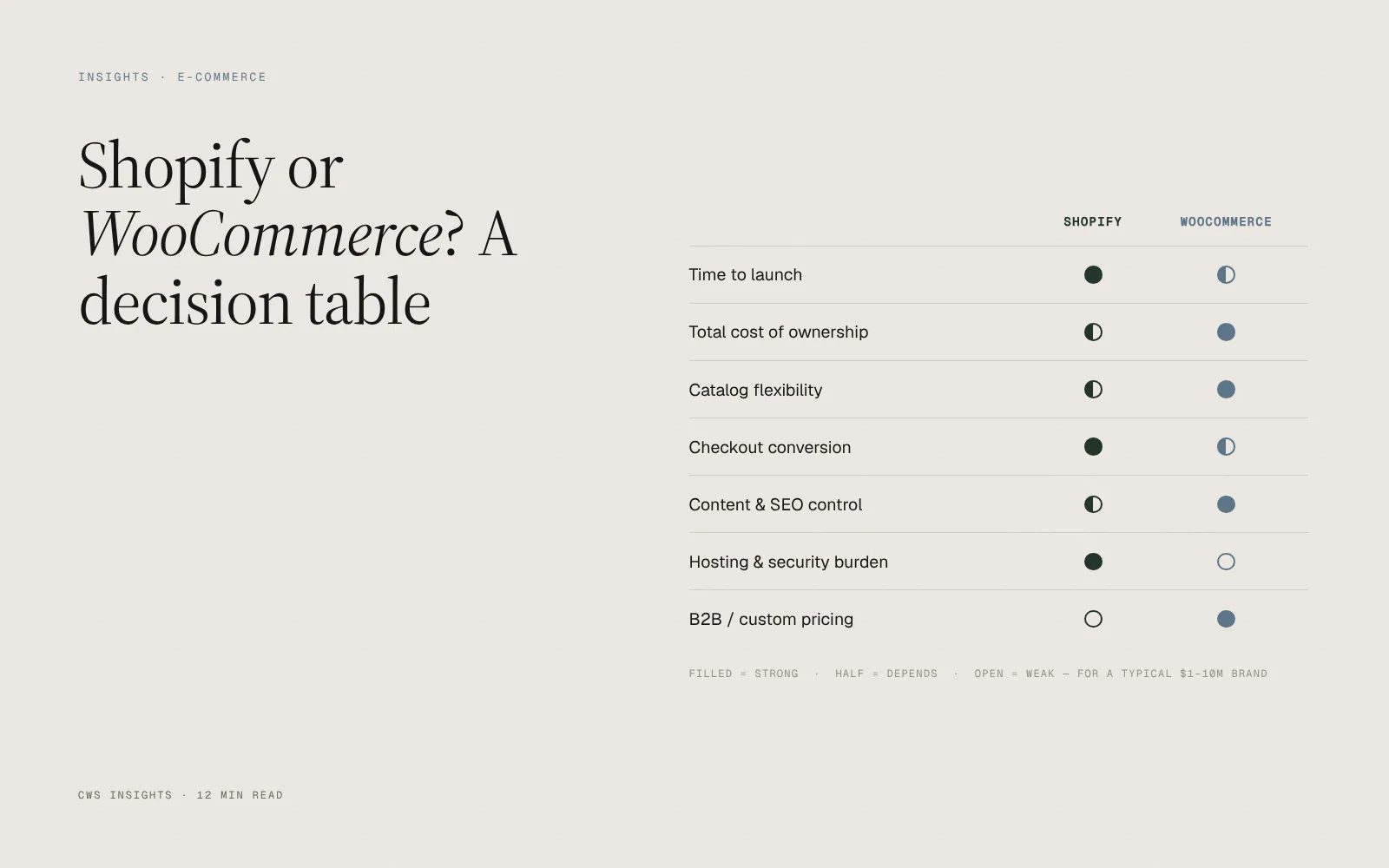
Comparing the practical factors
- Up-front build cost: broadly similar for a custom design on either platform. Complex requirements tend to cost less to build on WooCommerce and more on Shopify, where they need apps or workarounds.
- Ongoing cost: Shopify is more predictable; you pay subscription and app fees. WooCommerce costs are spread across hosting, licenses and maintenance, and they vary with complexity.
- Ease of daily use: Shopify’s admin is simpler for most merchandising tasks. WooCommerce is comfortable for teams who already know WordPress.
- Content and SEO: WooCommerce, through WordPress, offers more flexibility for content-heavy strategies. Shopify handles product SEO well but is more limited for complex content.
- Scalability: both can scale. Shopify scales with less effort; WooCommerce scales with good hosting and engineering.
Questions that usually decide it
Who will run the store every day? If it is a small marketing or operations team without technical support, Shopify’s managed environment is usually the safer choice.
How unusual is your product or pricing? Standard catalog products sell well on either. Configurators, custom quoting, tiered wholesale pricing and member pricing often push toward WooCommerce or Shopify Plus.
How important is content? If your growth depends on guides, articles and resources as much as product pages, WordPress has a real advantage.
What systems must it connect to? ERP, inventory, fulfillment and accounting integrations exist for both, but check the specific systems you use before deciding.
A note on B2B and wholesale
Many of the businesses we work with sell to both consumers and trade customers. Both platforms can handle this, but in different ways. Shopify offers B2B features on its Plus tier, including company accounts, customer-specific price lists and payment terms, which works well when your wholesale rules are fairly standard. WooCommerce handles B2B through extensions or custom development, which is more work up front but can model almost any pricing agreement, approval flow or ordering restriction. If wholesale is a meaningful share of revenue, map out your real pricing rules, including the exceptions your sales team grants by hand, before choosing. Those exceptions are usually where platform limits show up first.
What about migrating?
Moving between platforms is entirely possible but not trivial. Products, customers and order history can be migrated, though passwords typically cannot, so customers may need to reset them. URL redirects must be mapped carefully to protect search rankings. Plan migrations away from your busiest season, and expect a period of close monitoring after launch.
Our usual recommendation
For most direct-to-consumer brands selling a defined catalog, we recommend Shopify, often with a custom theme and a deliberately small app stack. For businesses where content, complex pricing or deep integration with internal systems matters more, WooCommerce on a well-maintained WordPress build is frequently the stronger long-term choice. The wrong answer is choosing a platform before you understand how you actually sell. A short discovery conversation usually makes the right path clear.